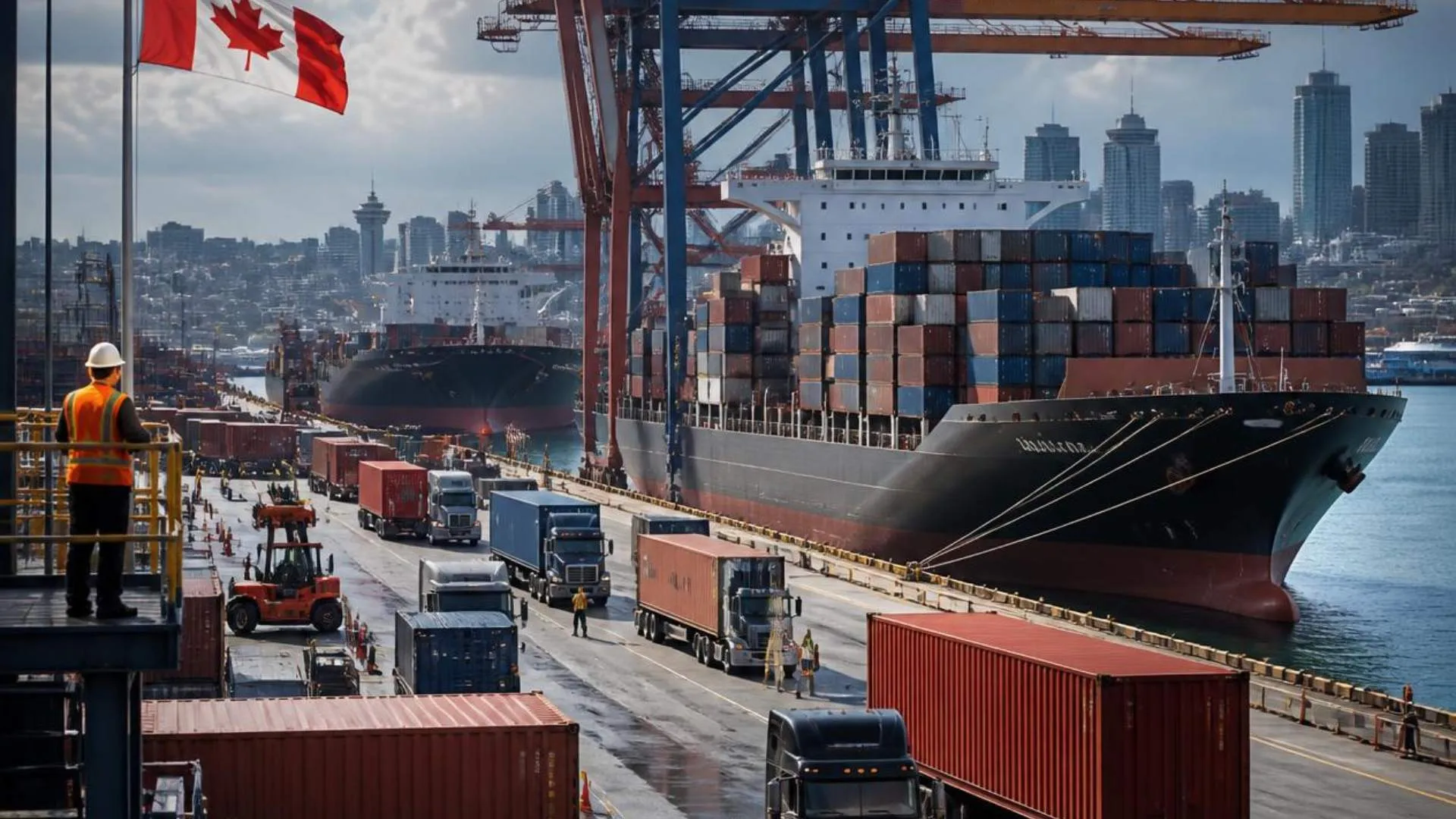

Why Are Trump Tariffs Increasing Shipping Costs?
Trump tariff shipping cost increases are happening because companies are rushing to move goods before new U.S. tariff deadlines, creating extra demand for container space and pushing freight rates higher. Tariffs do not only raise the tax paid at the border. They also change business behaviour before they take effect.
When importers expect higher duties, many bring orders forward. This is known as front-loading. That rush can create tighter shipping capacity, higher container rates, more fuel surcharges, longer booking delays and higher final costs for businesses.
Recent reporting from CTV News on shipping prices and new Trump tariffs and CBC News on shipping costs and Canada-U.S. tariffs shows that Canadian importers are facing pressure from both tariff uncertainty and wider global freight volatility.
Quick Summary: Trump Tariff Shipping Cost Increases
| Question | Clear Answer |
| What is happening? | Freight and container shipping prices are rising as companies move goods early before expected U.S. tariff changes. |
| Main cause | Importers are front-loading cargo to reduce tariff exposure and avoid supply disruption. |
| Canada impact | Canadian businesses may pay more for imported goods, freight, warehousing, customs compliance and cross-border distribution. |
| Products most affected | Clothing, footwear, electronics, furniture, toys, appliances, seasonal goods, auto parts and industrial inputs. |
| Consumer effect | Prices may rise gradually as higher shipping and import costs move through the supply chain. |
| Business risk | Small and mid-sized firms may face tighter margins, delayed shipments and less negotiating power with carriers. |
| Best action | Review landed cost, customs classification, supplier terms, shipping routes and tariff exposure before placing new orders. |
What Does “Trump Tariff Shipping Cost Increases” Mean?
The phrase Trump tariff shipping cost increases describes the rise in freight costs connected to new or expected U.S. tariffs under President Donald Trump’s trade policy.
A tariff is a duty charged on imported goods. However, the shipping-cost increase usually happens before the tariff is paid. Businesses try to avoid higher future duties by importing goods earlier. When thousands of companies make the same decision at the same time, demand for shipping space rises sharply.
That creates a chain reaction:
Businesses order earlier than planned. Freight forwarders compete for limited vessel space. Carriers raise spot rates. Importers pay more to secure containers. Warehouses and distribution networks become busier. Retailers later pass some of those costs to customers.
This is why tariff uncertainty can raise shipping costs even before a tariff officially begins.
What Recent Google Coverage Shows?
Recent Google-visible coverage around this topic shows five repeated themes.
First, companies are rushing to ship goods before possible tariff deadlines. Second, container rates on Asia-to-North America routes have risen sharply. Third, Canadian businesses are exposed because they share shipping routes and supply chains with U.S. importers. Fourth, fuel costs and geopolitical disruption are adding extra pressure. Fifth, the final cost may reach consumers through higher retail prices, reduced discounts or smaller product selections.
The U.S. Trade Representative has been central to the latest tariff discussion because new trade actions are being linked to Section 301 investigations and forced-labour enforcement concerns. Businesses following Canada-U.S. trade developments are also monitoring updates from organisations such as the Canadian Federation of Independent Business tariff tracker, which explains how tariff rules affect small and medium-sized companies.
Why Are Shipping Prices Rising Before New Tariffs Start?
Shipping prices rise before tariffs start because importers act on risk, not certainty.
A company does not need to wait until a tariff appears on an invoice. If there is a strong chance that goods will cost more next month, the company may decide to import now. That behaviour is logical for one business, but when many businesses do it together, the freight market becomes crowded.
This is especially visible on container routes from East Asia to North America. Many products sold in Canada and the United States move through the same manufacturing hubs, ports, carriers and freight-forwarding networks. When U.S. retailers accelerate orders, Canadian importers can face the same rate increases.
The pressure is not only about tariffs. Freight markets are also affected by fuel costs, port congestion, blank sailings, container availability, weather, geopolitical tension and peak retail season. Tariffs act as the trigger, while existing freight pressures make the price jump worse.
How Tariffs Increase the Real Cost of Shipping?
A tariff does not directly change the ocean freight rate. Instead, it changes demand and behaviour across the supply chain.
When a tariff deadline approaches, businesses may book shipping space urgently. Freight carriers know demand is rising, so spot-market prices can increase. Importers may pay premium rates to secure vessel space. Some shipments may also be rolled to later sailings if containers or capacity are limited.
The real landed cost may include:
Product cost, ocean freight, fuel surcharge, customs duty, brokerage fees, insurance, port handling, warehousing, inland trucking, currency movement and compliance paperwork.
For a Canadian retailer, the final impact is not just “tariff plus shipping.” It is the combined cost of getting goods from supplier to warehouse to customer.
Why Canada Is Exposed to U.S. Tariff-Driven Shipping Costs?
Canada is exposed because its supply chains are deeply connected to the U.S. economy.
Many Canadian businesses import from the same countries as U.S. retailers. They use similar ocean routes, freight forwarders, rail links, trucking networks and distribution hubs. When U.S. companies rush to import goods, they compete for the same containers and vessel capacity that Canadian companies need.
Canada is also affected by cross-border uncertainty. Some goods move into Canada directly. Others move through U.S. ports or are part of integrated North American production chains. A tariff change in the U.S. can therefore affect pricing, routing, paperwork and delivery planning for Canadian firms.
Businesses should check official customs and import rules through the Canada Border Services Agency import guide, especially when goods may be affected by duties, country-of-origin rules or changing documentation requirements.
What Products Could Become More Expensive?
The products most likely to be affected are goods that depend heavily on international container shipping or cross-border distribution.
These include:
Clothing, footwear, consumer electronics, toys, furniture, homeware, appliances, garden equipment, tools, auto parts, industrial machinery, seasonal retail goods and imported building materials.
Some food, packaging and manufacturing inputs may also be affected, depending on the country of origin, supply route and tariff classification.
Consumers may not see price increases immediately. Retailers often sell existing stock first. But when new inventory arrives with higher freight and import costs, businesses may raise prices, reduce promotions or change suppliers.
How Small Businesses Could Be Hit Harder?
Small and medium-sized businesses may feel tariff-related shipping cost increases more sharply than large retailers.
Large companies often have long-term carrier contracts, bigger customs teams, stronger supplier relationships and more warehouse flexibility. Smaller firms may rely more heavily on spot freight rates and may have less room to absorb sudden cost increases.
A small importer may face several problems at once: higher container rates, limited shipping availability, supplier uncertainty, higher customs-brokerage costs and weaker negotiating power. If the business cannot raise customer prices quickly, profit margins may shrink.
This is why small firms should calculate landed cost before confirming new orders. Landed cost gives a more realistic view of profitability than product price alone.
What Is Front-Loading and Why Does It Matter?
Front-loading means importing goods earlier than usual to avoid future cost increases or disruption.
In normal conditions, retailers plan shipments around seasonal demand. For example, fall and holiday inventory may move gradually over several months. When tariff deadlines appear, companies may bring those shipments forward into a shorter window.
This matters because ocean freight capacity is limited. Ships, containers and port slots cannot expand instantly. When too much cargo enters the system at once, freight prices rise.
Front-loading can protect a business from one risk while creating another. A company may avoid a future tariff but end up paying more for freight, storage or excess inventory.
Are Trump Tariffs the Only Reason Shipping Costs Are Rising?

No. Trump tariff uncertainty is one of the biggest triggers, but it is not the only reason.
Shipping costs are also being influenced by:
Fuel prices, Red Sea and Middle East disruption, port congestion, carrier capacity management, seasonal retail demand, blank sailings, container shortages and exchange-rate movement.
Freight markets are sensitive because they operate on planned capacity. If carriers reduce sailings or importers suddenly rush cargo, rates can move quickly. Tariffs add urgency to a market that may already be tight.
How Shipping Cost Increases Reach Consumers?
Shipping cost increases move through the economy in stages.
First, the importer pays more to bring goods into the country. Then the wholesaler or distributor may face higher handling, storage and delivery costs. Finally, the retailer decides whether to absorb the increase or pass it on.
Consumers may see the impact through higher shelf prices, fewer sales, smaller discounts, delayed product launches or reduced stock availability.
The price increase may not be labelled as a tariff. It may simply appear as a higher product price.
What Canadian Businesses Should Do Now?
Canadian businesses should not wait until tariffs are final before reviewing their exposure.
The first step is to identify which products are most dependent on international shipping. The second step is to calculate the full landed cost, including freight, duty, brokerage, insurance, warehousing and inland delivery. The third step is to check whether the product’s tariff classification and country-of-origin documents are accurate.
Businesses should also ask suppliers whether pricing is fixed, whether shipments can be split, whether alternative routes are available and whether contracts include fuel or tariff adjustment clauses.
For cross-border trade, companies should monitor official U.S. trade updates through the Office of the United States Trade Representative and Canadian customs guidance through the Canada Border Services Agency.
Practical Checklist for Importers
Before placing a new order, Canadian importers should check:
| Area | What to Review |
| Product classification | Confirm HS codes and customs category. |
| Country of origin | Check whether goods qualify for preferential treatment or face higher duty risk. |
| Freight quote | Compare spot rates, contract rates, fuel surcharges and premium booking fees. |
| Supplier terms | Review who pays freight, insurance, duties and customs charges. |
| Delivery timing | Decide whether early shipping is worth the extra storage cost. |
| Inventory risk | Avoid over-ordering goods that may sell slowly. |
| Customer pricing | Plan whether price increases can be passed on without damaging demand. |
| Documentation | Keep invoices, origin certificates, freight records and customs paperwork organised. |
Could Shipping Costs Come Down Again?
Shipping costs could fall if the front-loading rush slows, tariff rules become clearer, carriers restore capacity or demand weakens after early orders are completed.
However, prices may stay elevated if tariff uncertainty continues, fuel costs remain high, geopolitical risks disrupt routes or carriers restrict available capacity.
Businesses should plan for volatility rather than assume freight prices will quickly return to normal. A flexible supply-chain plan is safer than relying on one supplier, one route or one shipping window.
What This Means for Canadian Consumers?

For Canadian consumers, the biggest risk is gradual price pressure.
Goods that rely on imported parts, long-distance shipping or cross-border distribution may become more expensive. The effect may be most visible in retail categories such as clothing, electronics, home goods, furniture, toys, tools and seasonal merchandise.
Consumers may also notice fewer discounts or longer delivery times. Businesses often try to protect margins quietly before making major price changes.
Expert-Led View: The Main Risk Is Uncertainty
The main risk is not just the tariff itself. It is uncertainty.
When companies do not know which goods will be affected, when tariffs will apply or whether exemptions will be available, they make defensive decisions. Those decisions can raise costs across the whole shipping market.
That is why Trump tariff shipping cost increases matter even to businesses that are not directly importing into the United States. The global freight system is connected, and pressure on one major route can affect pricing behaviour elsewhere.
Bottom Line
Trump tariff shipping cost increases are a supply-chain warning sign for Canada. The issue is not only the tariff charged at the border. It is the wider reaction from businesses trying to move goods before costs rise further.
For Canadian companies, the best response is to calculate full landed cost, monitor official tariff updates, review supplier contracts and plan inventory carefully. For consumers, the likely effect is gradual price pressure on imported goods rather than one sudden visible charge.
Tariff uncertainty can raise shipping costs before tariffs even begin. Businesses that prepare early will be in a stronger position than those that wait for the final deadline.
FAQs About Trump Tariff Shipping Cost Increases
What are Trump tariff shipping cost increases?
Trump tariff shipping cost increases are higher freight and logistics costs linked to new or expected U.S. tariffs. They happen when companies rush to import goods before tariff deadlines, increasing demand for container space.
Why do tariffs increase shipping prices?
Tariffs increase shipping prices indirectly. Businesses bring goods forward to avoid higher duties, which increases demand for limited freight capacity. Carriers can then charge higher spot rates.
Are Canadian businesses affected by U.S. tariffs?
Yes. Canadian businesses can be affected because Canada and the U.S. share connected supply chains, freight routes, ports, suppliers and cross-border distribution systems.
Will consumers pay more because of shipping cost increases?
Consumers may pay more if retailers pass higher freight, duty and storage costs into final product prices. The increase may appear gradually rather than immediately.
Which goods are most at risk?
Imported goods moved by container are most exposed. This includes electronics, clothing, footwear, furniture, appliances, toys, tools, auto parts and seasonal retail products.
Can businesses avoid tariff-related shipping increases?
Businesses may not be able to avoid all increases, but they can reduce risk by reviewing landed cost, comparing routes, confirming customs documents, negotiating supplier terms and avoiding rushed last-minute shipping.
Are shipping costs expected to stay high?
Shipping costs could ease if the import rush slows and tariff rules become clearer. However, prices may remain volatile if fuel costs, geopolitical disruption or trade-policy uncertainty continue.
Editorial note: This article explains publicly reported tariff and freight-market developments. It is for general information only and should not replace customs, legal, tax or trade-compliance advice.