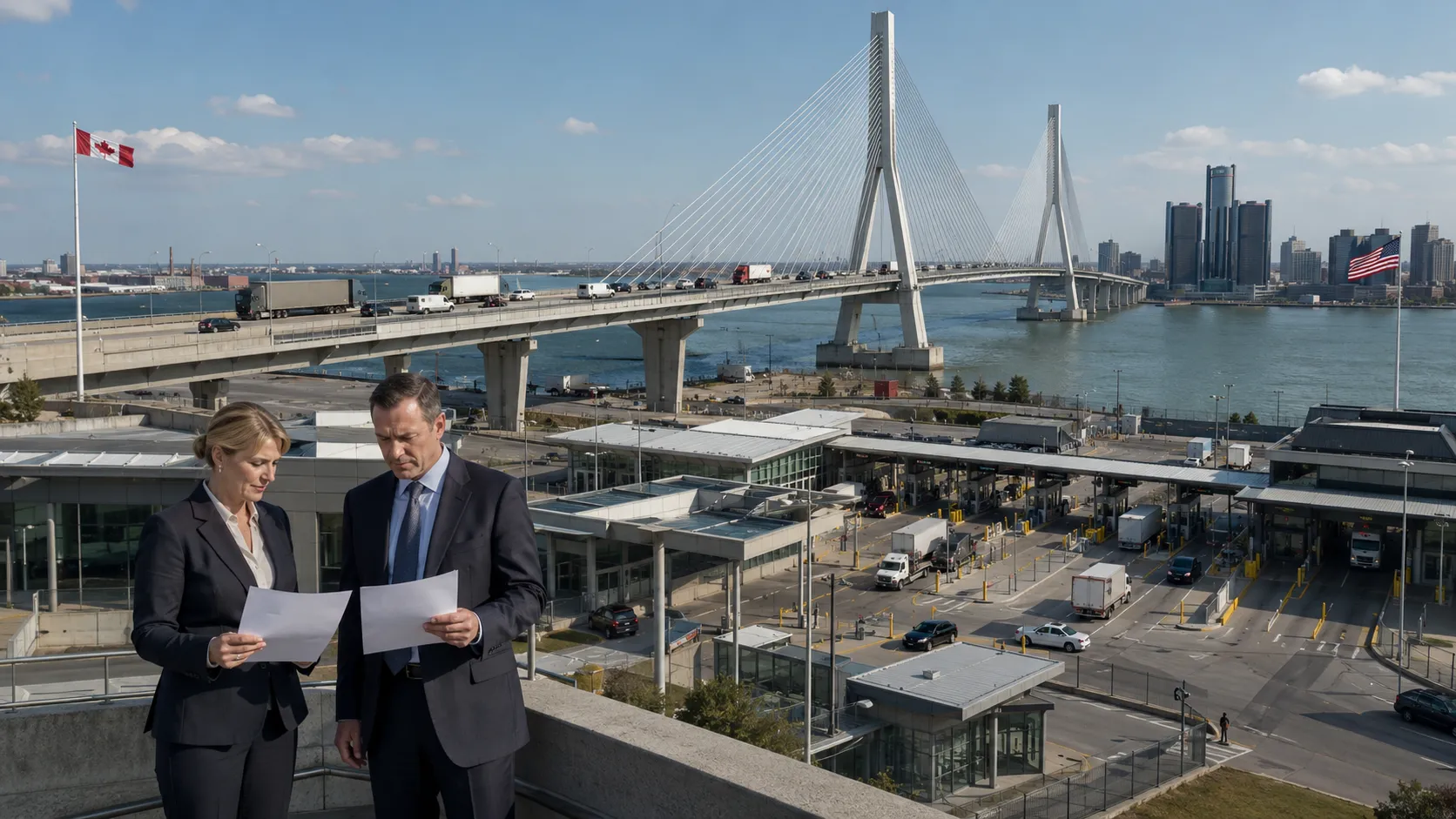

The Gordie Howe Bridge US–Canada deal cleared a major political obstacle to opening the new international crossing between Windsor, Ontario, and Detroit, Michigan. However, the agreement has also created questions about how much bridge revenue the United States will receive and whether Canada made a larger financial concession than Prime Minister Mark Carney initially suggested.
The Gordie Howe International Bridge remains scheduled to open to vehicles on July 27, 2026. The bridge was originally expected to open earlier, but unresolved disagreements with the US government delayed the launch. Canada and the United States subsequently reached new arrangements covering toll oversight, financial transparency and a 15-year economic development fund connected to bridge profits.
Canada later cancelled a planned joint opening celebration after US President Donald Trump threatened new 50% tariffs on a range of Canadian products. A Canadian-only ceremony was scheduled for July 24, while the planned July 27 traffic opening remained in place as of July 22, 2026.
Gordie Howe Bridge Deal at a Glance
| Key issue | Current position |
| Scheduled opening date | July 27, 2026 |
| Locations connected | Windsor, Ontario, and Detroit, Michigan |
| Original financing | Canada financed the project |
| Ownership | Publicly owned jointly by Canada and Michigan |
| Toll collection | Tolls are collected on the Canadian side |
| New US benefit | A share of qualifying net bridge revenue |
| Revenue-sharing period | 15 years |
| Use of US share | Regional economic development |
| Toll oversight | US consultation or concurrence for certain changes |
| Joint celebration | Cancelled amid renewed trade tensions |
| Canadian celebration | Planned for July 24, 2026 |
What Is the Gordie Howe Bridge US–Canada Deal?

The agreement announced in July 2026 is a set of additional measures intended to resolve US concerns and allow the bridge to begin operating.
The Government of Canada described the arrangement as involving greater toll transparency, collaboration on toll-rate adjustments and a 15-year economic development fund linked to a portion of bridge operating profits.
The Windsor–Detroit Bridge Authority will work with the US government on certain toll changes. Official information says the authority will seek US concurrence for particular non-market-related adjustments, although the government has not published a complete legal explanation of which toll decisions require approval.
Media reports, citing sources familiar with the discussions, said the agreement would direct approximately half of eligible toll profits to the US side and give the United States a form of veto over toll increases exceeding 10% above existing rates. Those reported terms have not been fully confirmed through a publicly released signed agreement.
The distinction between toll revenue, operating profit and net revenue is central to understanding the deal. The United States is not expected to receive half of every dollar collected at the toll booths. Its share is reportedly calculated after specified operating and maintenance expenses have been deducted.
What Did the Original Canada–Michigan Agreement Say?
The Gordie Howe International Bridge was established through the Canada Michigan Crossing Agreement, signed in June 2012.
Under that original framework:
- Canada agreed to finance construction and related land acquisition.
- Canada funded the Michigan interchange connecting the bridge to Interstate 75.
- Tolls for traffic travelling in both directions would be collected in Canada.
- Toll proceeds would be used to reimburse the Canadian government.
- The crossing would be jointly and publicly owned by Canada and Michigan.
- Canada and Michigan would have equal representation on the International Authority.
These provisions meant that Canada assumed the project’s financial risk while Michigan received a major new border crossing and highway connection without initially providing an equivalent construction contribution.
The structure was accepted because the bridge was expected to benefit both countries economically while providing Canada with a way to recover its investment through long-term toll collections.
What Changed Under the New Bridge Agreement?
The 2026 deal does not appear to replace the entire 2012 crossing agreement. Instead, it adds new toll-governance and revenue-sharing arrangements.
The major reported changes include:
A 15-year Economic Development Fund
Part of the bridge’s net operating revenue will support economic development, particularly on the US side of the Windsor–Detroit corridor.
A Share of Net Revenue for the United States
Reporting indicates that half of the qualifying revenue remaining after operating expenses may be directed to the US economic development fund.
Additional Us Involvement in Toll Decisions
The bridge authority must consult the US government and seek concurrence for certain non-market toll-rate changes.
Greater Financial Transparency
Canada and the United States agreed to additional cooperation concerning bridge finances and toll governance.
The official announcement did not disclose the complete formula for calculating the economic development contribution. It also did not provide detailed projections showing how much money Canada could transfer to the US fund during each of the 15 years.
Will Canada Be Repaid Before Revenue Is Shared?
This is the most disputed part of the Gordie Howe Bridge deal.
Prime Minister Mark Carney initially indicated that Canada would recover its bridge investment before meaningful toll revenue was divided with the United States. He later said that any sharing would involve net revenue after operating costs such as maintenance and snow removal.
However, subsequent reporting indicated that revenue may be divided during the bridge’s first 15 years of operation after operating expenses but before Canada has completely recovered the construction debt.
Under that reported interpretation:
- Operating and maintenance expenses are paid first.
- The remaining net operating revenue is divided.
- Half supports the US economic development fund.
- Canada retains the other half.
- Canada uses its portion to help recover the bridge investment.
That structure would differ materially from an arrangement in which Canada keeps all available revenue until the entire construction cost has been repaid.
The federal government had not publicly released the complete agreement as of July 22, leaving important questions about debt servicing, depreciation, capital costs and the definition of net revenue unresolved.
Reuters reported that Canada expected net profits to be modest during the early operating years, meaning the immediate US payment could be limited even if revenue sharing begins before the debt is fully repaid.
Is the Gordie Howe Bridge Deal Good for Canada?

The answer depends on whether the agreement is judged financially, politically or economically.
Why the Deal May Still Benefit Canada?
The bridge can now open and begin generating toll revenue rather than remaining unused during a prolonged political dispute.
Opening the crossing may also provide:
- Additional border capacity
- More competition between Windsor–Detroit crossings
- Direct access between Highway 401 and Interstate 75
- Reduced reliance on the Ambassador Bridge
- More reliable commercial trucking routes
- Greater resilience during closures or border disruptions
- Faster movement of automotive and manufacturing supplies
The bridge’s opening could therefore produce economic benefits that are considerably larger than the amount eventually contributed to the US development fund.
The official project release describes the Windsor–Detroit corridor as North America’s busiest international land border crossing. The six-lane bridge includes modern ports of entry and a direct highway connection intended to improve the movement of commercial and passenger traffic.
Why the Deal Has Been Criticized?
Critics argue that Canada paid for the project and should not have needed to offer additional revenue simply to obtain US cooperation for its opening.
Other concerns include:
- The full agreement has not been published.
- The definition of net revenue remains unclear.
- Revenue sharing could slow Canada’s investment recovery.
- US involvement could restrict future toll-setting decisions.
- Canada negotiated after the US threatened to delay the bridge.
- Public statements about the repayment sequence have appeared inconsistent.
Opposition politicians have called for the complete agreement and financial projections to be released. Their central argument is that Canadian taxpayers cannot properly evaluate the arrangement without knowing how much revenue is expected to be transferred and how the change affects the repayment period.
A balanced assessment is that the deal may be less financially favourable than the original Canada–Michigan model, but opening the bridge could still deliver a substantial net economic benefit to Canada.
Why Was the Joint Bridge Celebration Cancelled?
Canada cancelled the joint Canadian–American opening celebration following renewed trade threats from President Donald Trump.
A ceremony involving officials from both countries had been planned for July 24. The Canadian government said that a shared celebration would be inappropriate after Trump announced proposed 50% tariffs on a broad range of Canadian imports.
Canada instead planned to hold its own ceremony to recognize the workers, officials and communities involved in delivering the bridge. It was unclear whether the United States would organize a separate event.
The cancellation illustrates the difference between the bridge’s operational importance and the wider political relationship. Canada and the United States continue to depend heavily on cross-border infrastructure even when their governments disagree on tariffs and trade policy.
Does the Cancelled Ceremony Affect the Opening Date?
The cancellation of the joint celebration does not automatically cancel or delay the bridge’s operational opening.
The Canadian government said it remained committed to opening the crossing on July 27, 2026. However, because the bridge is an international port of entry, its operation also depends on border agencies, customs systems, staffing and administrative coordination on both sides.
The safest description is therefore that the Gordie Howe International Bridge remains scheduled to open on July 27, rather than stating that the opening is guaranteed.
Travellers and commercial operators should check official bridge updates before planning a crossing during the first days of operation.
Who Owns the Gordie Howe International Bridge?
The bridge is publicly owned jointly by the Government of Canada and the State of Michigan.
It is managed by the Windsor–Detroit Bridge Authority, a Canadian Crown corporation responsible for overseeing the project’s delivery and operation. The International Authority includes equal representation from Canada and Michigan.
Joint ownership does not mean that both parties paid equal construction costs. Canada agreed to advance the project’s major costs, including work and land requirements on the US side, with repayment expected through toll revenue.
This distinction became politically important after Trump previously demanded greater US ownership. Michigan was already a joint public owner under the original agreement, even though Canada carried the project’s financing burden.
How Important Is the Bridge for Canada–US Trade?
The Windsor–Detroit corridor is essential to automotive manufacturing, agriculture, retail supply chains and the movement of industrial goods.
The new bridge provides a direct connection from Ontario’s Highway 401 to Michigan’s Interstate 75. This means commercial vehicles can avoid some of the local streets and traffic signals associated with older crossing routes.
The crossing includes:
- Six vehicle lanes
- Canadian and US ports of entry
- Advanced border-screening systems
- A direct interstate and highway connection
- Dedicated commercial processing facilities
- A pedestrian and cycling path
The bridge’s main span measures 853 metres, making it the longest cable-stayed main span in North America, according to the official project announcement.
The Ambassador Bridge will remain an important commercial route, but the Gordie Howe crossing gives carriers and travellers another option. That competition could influence toll prices, congestion and service quality across the Windsor–Detroit corridor.
What Happens Next?
Several developments will determine how the agreement ultimately affects Canada.
The most important issues to watch are:
- Whether the bridge opens as scheduled on July 27
- Whether the complete agreement is publicly released
- How net revenue is officially defined
- When payments to the US development fund begin
- How much Canada receives for debt repayment
- Which toll increases require US concurrence
- Whether tariffs create new border disruptions
- How quickly commercial traffic moves to the new crossing
- Whether the Ambassador Bridge adjusts its tolls
Actual traffic and operating expenses will determine whether the economic development fund receives substantial revenue. Early projections may change as drivers, trucking companies and supply-chain operators decide which crossing best meets their needs.
Final Considerations
The Gordie Howe Bridge US–Canada deal appears to have achieved its immediate objective: removing a political barrier to opening one of North America’s most important new border crossings.
Canada maintained the original public ownership structure and the right to use toll revenue to recover its investment. However, it also agreed to additional US involvement in toll governance and a 15-year fund receiving part of the bridge’s net operating revenue.
The arrangement may therefore be more costly to Canada than Prime Minister Carney’s first explanation suggested, particularly if revenue is shared before the construction debt is fully repaid. At the same time, keeping a completed multibillion-dollar bridge closed would have imposed its own economic costs on businesses, travellers and cross-border supply chains.
A definitive financial assessment will require the Canadian government to publish the complete agreement, the revenue-sharing formula and updated projections for repaying the project’s costs.
Editorial note: This report reflects official announcements and reporting available on July 22, 2026. The opening date and trade measures may change as negotiations continue.
Frequently Asked Questions
What is the Gordie Howe Bridge US–Canada Deal?
It is an additional agreement covering toll governance, financial transparency and a 15-year economic development fund connected to bridge operating profits.
When Will the Gordie Howe Bridge Open?
The bridge is scheduled to open to vehicle traffic on July 27, 2026.
Did Canada Pay for the Gordie Howe Bridge?
Canada financed the project, including major construction, land and interchange costs on both sides of the border.
Who Owns the Gordie Howe International Bridge?
The bridge is publicly owned jointly by the Government of Canada and the State of Michigan.
Will the United States Receive Half of All Toll Revenue?
Not according to the available descriptions. Reporting indicates that the US share concerns qualifying net operating revenue after certain expenses, not half of gross toll collections.
Will Canada Be Repaid Before Sharing Bridge Profits?
The sequence remains disputed. Later reporting suggests net operating revenue may be shared during the first 15 years while Canada is still recovering its investment.
Why Was the Joint Bridge Ceremony Cancelled?
Canada cancelled the joint event after President Trump threatened 50% tariffs on a range of Canadian goods.
Is the July 27 Opening Cancelled?
No cancellation has been announced. Canada continued to state that the bridge would open on July 27 as of July 22, 2026.
Can the United States Control Bridge Tolls?
The US government will have additional involvement in certain non-market toll changes. The exact scope of that authority has not been fully published.
Why is the Gordie Howe Bridge Important?
It creates a modern, direct highway connection between Highway 401 and Interstate 75 and adds capacity to the busiest Canada–US commercial border corridor.