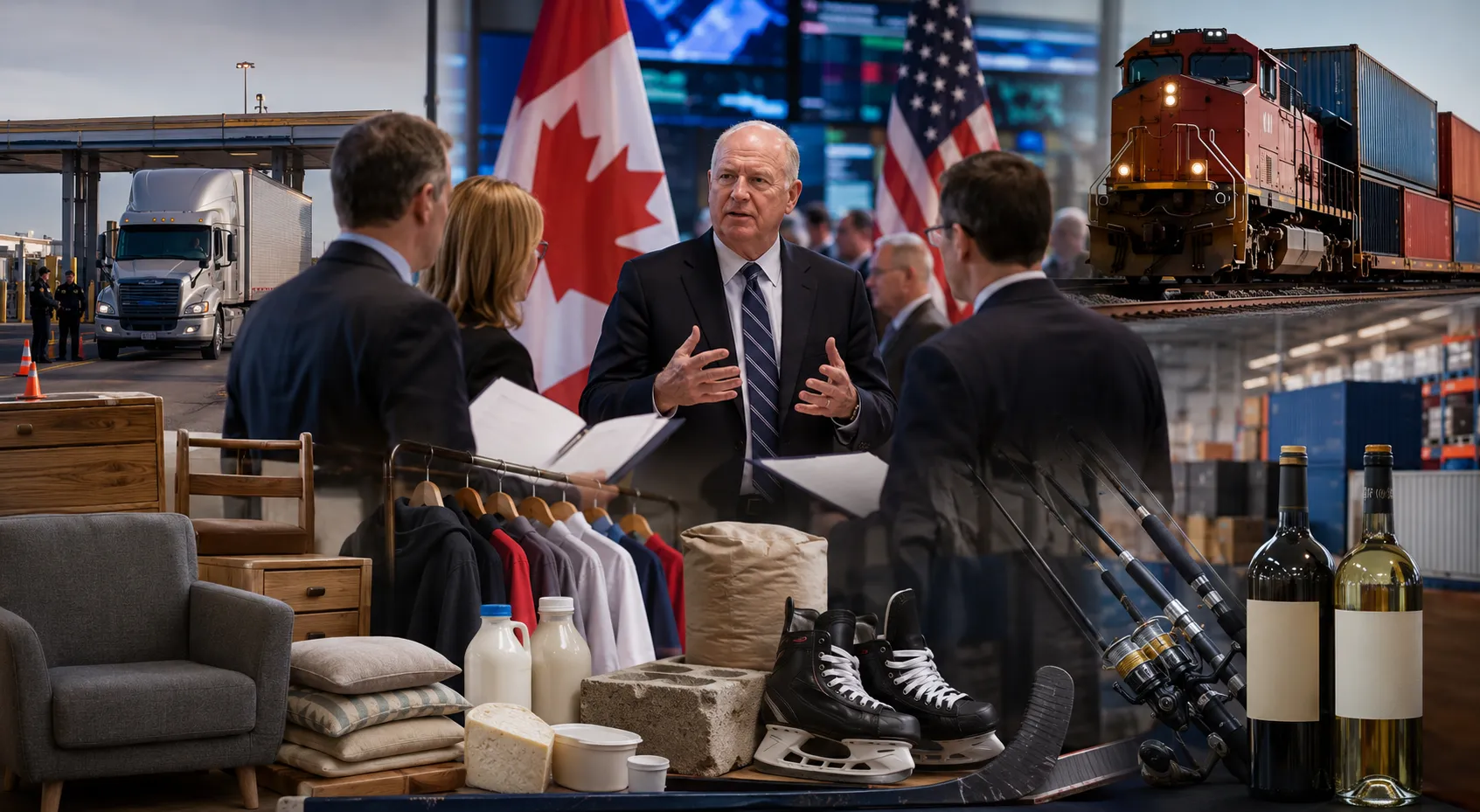

United States Ambassador to Canada Pete Hoekstra has defended the Trump administration’s trade strategy as Washington prepares to impose new 50% tariffs on approximately US$20 billion worth of Canadian products.
The measures were announced on July 20, 2026, and are scheduled to take effect on August 19 unless negotiations between Ottawa and Washington produce an agreement during the 30-day notice period.
The new duties will affect products including Canadian wine, cement, dairy goods, furniture, clothing, fishing equipment, swimming pools, seeds, wigs and ice hockey equipment. Energy products, potash, fish and critical minerals are among the major exemptions, according to Reuters’ report on the new Canadian tariffs.
Hoekstra has argued that the administration’s tariff policies are intended to protect American industries and correct what Washington considers unequal access to the Canadian market.
The announcement creates another challenge for Canadian exporters already dealing with changing trade relationships, supply-chain uncertainty and efforts to diversify beyond the United States. Canada has also pursued new arrangements with other markets, including the recently announced Canada-China canola and electric vehicle trade agreement.
Why Is the US Introducing New 50% Tariffs on Canada?

The Trump administration says Canada has discriminated against American automobiles, alcohol and dairy products.
Washington has pointed to Canadian tariffs and quotas affecting US-made vehicles, restrictions created by Canada’s dairy supply-management system and decisions by most Canadian provinces to stop purchasing or selling American alcohol.
Canadian provincial restrictions on US alcohol were largely introduced in response to earlier American tariffs and President Trump’s repeated comments about Canada becoming the “51st state.”
The White House says imports of American alcoholic beverages into Canada fell by 81% over the previous year, while imports of US motor vehicles dropped by 22%.
Canada disputes Washington’s characterization. Prime Minister Mark Carney has said Canadian automotive measures matched tariffs previously imposed by the United States and that several American trade actions violated the Canada–United States–Mexico Agreement.
The Government of Canada maintains an official overview of Canada’s trade and economic engagement with the United States, including its responses to earlier American tariffs.
What Has Pete Hoekstra Said About US-Canada Trade?
Pete Hoekstra has consistently supported the Trump administration’s approach while urging Canada to demonstrate why closer trade with Canadian businesses benefits the United States.
Speaking at the Pacific Northwest Economic Region’s annual summit in Edmonton on July 20, Hoekstra said Canada remained one of the best places in the world for the United States to obtain oil.
He explained that Canadian energy is geographically close and that companies in Alberta have historically been dependable commercial partners. However, he also stressed that the United States could obtain additional oil from suppliers outside Canada.
His position reflects a central argument used by the Trump administration: the United States may value Canadian resources, but access to the American market should not be assumed.
Hoekstra has previously encouraged Canadian governments and companies to make a stronger economic case for receiving the lowest available US tariff rates. He has also criticized Canadian boycotts, restrictions on American products and provincial measures preventing US companies from bidding for certain contracts.
Hoekstra’s official statements and diplomatic announcements can be reviewed through the US Embassy and Consulates in Canada.
Which Canadian Products Will Face the 50% Tariff?
The tariff package covers a broad but targeted range of Canadian exports.
Products identified in US announcements and reporting include:
- Wine and certain other alcoholic products
- Cement
- Dairy products
- Furniture
- Clothing
- Ice hockey sticks and other sports equipment
- Fishing rods
- Swimming pools
- Seeds
- Wigs
The US Trade Representative estimates that the affected imports are worth almost US$20 billion annually. That represents approximately 5.2% of the US$382 billion in goods imported by the United States from Canada during 2025.
The tariffs are significant because some affected products previously qualified for preferential treatment under the continental trade agreement.
Canadian companies should not assume that every product within a broad category will receive identical treatment. The customs classification, country-of-origin rules and wording of the final tariff schedule will determine whether a particular shipment is affected.
Which Canadian Exports Are Exempt?

Several economically important Canadian exports have been excluded from the new tariff package.
The principal exemptions include:
- Oil and other energy products
- Potash
- Fish
- Critical minerals
- Products already covered by separate Section 232 tariffs
Exempting energy and critical materials limits the immediate impact on some of the most integrated North American supply chains.
Canada is a major supplier of energy and industrial inputs to the United States. Applying a 50% tariff to those products could rapidly increase costs for American refineries, manufacturers, farmers and consumers.
However, exemptions do not eliminate the wider uncertainty facing Canadian exporters. Companies must determine whether each shipment falls within an exempt customs classification or one of the newly targeted categories.
Border infrastructure and customs processing will also remain important. The ongoing Ambassador Bridge property dispute demonstrates why predictable border access matters to trucking, manufacturing, warehousing and cross-border distribution businesses.
What Is Section 338 of the Tariff Act?
President Trump is imposing the tariffs through Section 338 of the US Tariff Act of 1930.
The provision allows a president to impose additional duties of up to 50% on imports from countries found to discriminate against American commerce.
The action appears to be the first known use of Section 338 since the law was enacted nearly a century ago. Previous presidents considered using the provision, but researchers have found no confirmed example of it being formally applied before the 2026 Canadian measures.
The law was designed to respond when a country gives more favourable tariff treatment to other trading partners than it gives the United States.
Trade specialists have questioned whether using it against Canadian retaliation is consistent with the original purpose of the provision. Some argue that Canada introduced many of the disputed restrictions only after the United States imposed its own tariffs.
The legal authority may therefore face scrutiny, even though Section 338 provides the president with broad language for responding to alleged discrimination.
The World Trade Organization’s tariff guidance explains that tariffs are customs duties placed on imported merchandise and can give domestically produced goods a price advantage over competing imports.
How Has Canada Responded?
Prime Minister Mark Carney has said Canada is prepared to engage intensively with the United States to resolve outstanding trade disputes.
He maintained that the conflict has increased costs for families, particularly in the United States, and said Canada had already presented comprehensive proposals to Washington.
Ontario Premier Doug Ford has called for a stronger response if the duties proceed. Ford said Canada should retaliate “tariff for tariff, dollar for dollar.”
The Canadian Chamber of Commerce described the announcement as a regrettable escalation but urged both governments to use the 30-day notice period to begin meaningful formal negotiations.
Business groups on both sides of the border have warned that further retaliation could damage companies that rely on highly integrated North American supply chains.
Canada has previously imposed retaliatory measures against American goods. The Department of Finance provides official details about Canadian tariffs introduced in response to US steel and aluminum duties.
When Will the New US Tariffs Take Effect?

The 50% tariffs are scheduled to take effect on August 19, 2026.
The delayed implementation gives Canada and the United States approximately 30 days to negotiate.
The duties are not yet being collected, and the final position could change before the deadline. President Trump has previously delayed, modified or withdrawn tariff measures following negotiations with affected countries.
Canadian exporters should nevertheless prepare on the assumption that the duties will begin as announced.
Businesses may need to:
- Confirm the customs classification of exported goods
- Review contracts to determine who pays additional duties
- Recalculate landed costs and profit margins
- Discuss pricing changes with American customers
- Assess whether products qualify for an exemption
- Consider alternative markets or supply arrangements
- Document the origin of materials and finished products
- Review insurance and currency-exchange exposure
Companies should obtain advice from qualified customs brokers, trade lawyers or government export-support services before changing tariff classifications or shipping structures.
Could the Tariffs Increase Prices in the United States?
Tariffs are collected from US importers when affected products enter the country.
Although foreign producers may absorb part of the cost by reducing prices, American importing businesses frequently pass at least some of the additional expense to wholesalers, retailers or consumers.
A 50% duty could make some Canadian products considerably more expensive in the US market. Importers might reduce orders, search for alternative suppliers or remove products that are no longer commercially viable.
American businesses using Canadian cement, furniture, agricultural goods or specialist equipment could also face higher input costs.
The Associated Press analysis of the tariff announcement reported that economists and administration opponents expect the measures to create inflation risks and potentially trigger further Canadian retaliation.
US fiscal and regulatory changes can have wider consequences for Canadian companies beyond tariffs. ENBusiness.ca has also examined how major US economic policies could affect Canadian trade and energy ties.
What Happens Next in the US-Canada Tariff Dispute?
The immediate focus will be the negotiation period before August 19.
Potential areas of discussion include provincial restrictions on American alcohol, access to Canada’s dairy market, automotive tariffs and the future operation of the continental trade relationship.
The latest announcement does not mean that every Canadian export will face a 50% tariff. It applies to selected product groups, while energy, potash, fish, critical minerals and several separately regulated categories remain excluded.
However, the use of Section 338 represents a major escalation because it extends duties to products that previously received preferential treatment.
For Canadian businesses, the most important developments will be whether negotiations formally begin, whether the product list is revised and whether Ottawa announces retaliatory measures.
Exporters should monitor official announcements rather than relying solely on general product lists. Small differences in customs codes can determine whether a product receives an exemption or becomes subject to the full tariff.
Conclusion
The latest Pete Hoekstra US Canada tariffs dispute marks another escalation in cross-border trade tensions. Although the proposed 50% duties target selected Canadian products rather than all exports, the measures could still affect manufacturers, retailers, importers and consumers on both sides of the border.
With the tariffs scheduled to begin on August 19, 2026, the next few weeks will be critical. Canadian businesses should monitor official government announcements, confirm product classifications and prepare for possible changes to costs, contracts and shipping arrangements.
The final impact will depend on whether Canada and the United States reach an agreement before the implementation date or move towards further retaliation.
Key Facts About the New US Tariffs
| Detail | Current information |
|---|---|
| Tariff rate | 50% |
| Announcement date | July 20, 2026 |
| Scheduled start date | August 19, 2026 |
| Estimated imports affected | Nearly US$20 billion |
| Legal authority | Section 338 of the US Tariff Act of 1930 |
| Main targeted sectors | Alcohol, dairy, cement, furniture, clothing and consumer products |
| Major exemptions | Energy, potash, fish and critical minerals |
| Current status | Announced but not yet in effect |
Frequently Asked Questions
Did Pete Hoekstra Introduce the Tariffs?
No. The tariffs were imposed by President Donald Trump’s administration. Pete Hoekstra is the United States ambassador to Canada and has publicly defended the administration’s wider trade strategy.
Are All Canadian Goods Facing a 50% Us Tariff?
No. The duties apply to selected Canadian products worth nearly US$20 billion. Energy, potash, fish, critical minerals and certain goods covered by other tariff programmes are exempt.
Do Cusma-compliant Products Automatically Avoid the New Tariff?
Not necessarily. The new Section 338 duties can affect listed products even when they previously qualified for preferential treatment under CUSMA.
Can the Tariffs Be Cancelled Before August 19?
Yes. The 30-day implementation period allows time for negotiations, and the US administration could amend, postpone or withdraw the measures.
Who Pays a Tariff on Canadian Goods Entering the Us?
The US importer normally pays the tariff to American customs authorities. However, Canadian exporters can still be affected if importers demand lower prices, reduce orders or switch suppliers.
Will Canadian Consumers Pay the Us Tariff?
The duty is not collected directly from Canadian consumers. Canadians may nevertheless experience indirect effects through lost export sales, reduced production, employment pressure or Canadian retaliatory tariffs.
Where Should Businesses Check for Official Updates?
Businesses should review announcements from the Government of Canada, US customs authorities, trade departments and qualified customs professionals. News reports can provide context but should not replace product-specific customs advice.