
Becoming an air traffic controller in Canada involves passing a competitive NAV CANADA selection process, completing paid classroom and simulator training, gaining supervised operational experience and meeting Transport Canada’s medical and licensing standards.
A university degree, pilot licence or previous aviation experience is not required. Applicants generally need a high school diploma, Canadian citizenship or permanent resident status, strong communication skills and the ability to make accurate decisions under pressure.
NAV CANADA provides the required professional training to successful candidates. However, the selection process is demanding, and passing one assessment does not guarantee an invitation to the next stage.
What Does an Air Traffic Controller Do in Canada?
An air traffic controller manages the safe and efficient movement of aircraft through Canadian airspace and at controlled airports.
Controllers communicate with pilots, issue clearances, organize aircraft movements and maintain safe separation between flights. Their responsibilities may include directing aircraft during:
- Ground movement and taxiing
- Takeoff and landing
- Climb and descent
- Airport approaches
- High-altitude and cross-country travel
- Weather disruptions and emergency situations
Controllers must process several pieces of information simultaneously while communicating in a concise and unambiguous manner.
There are two main air traffic control career paths within NAV CANADA.
What Does a Tower Controller Do?
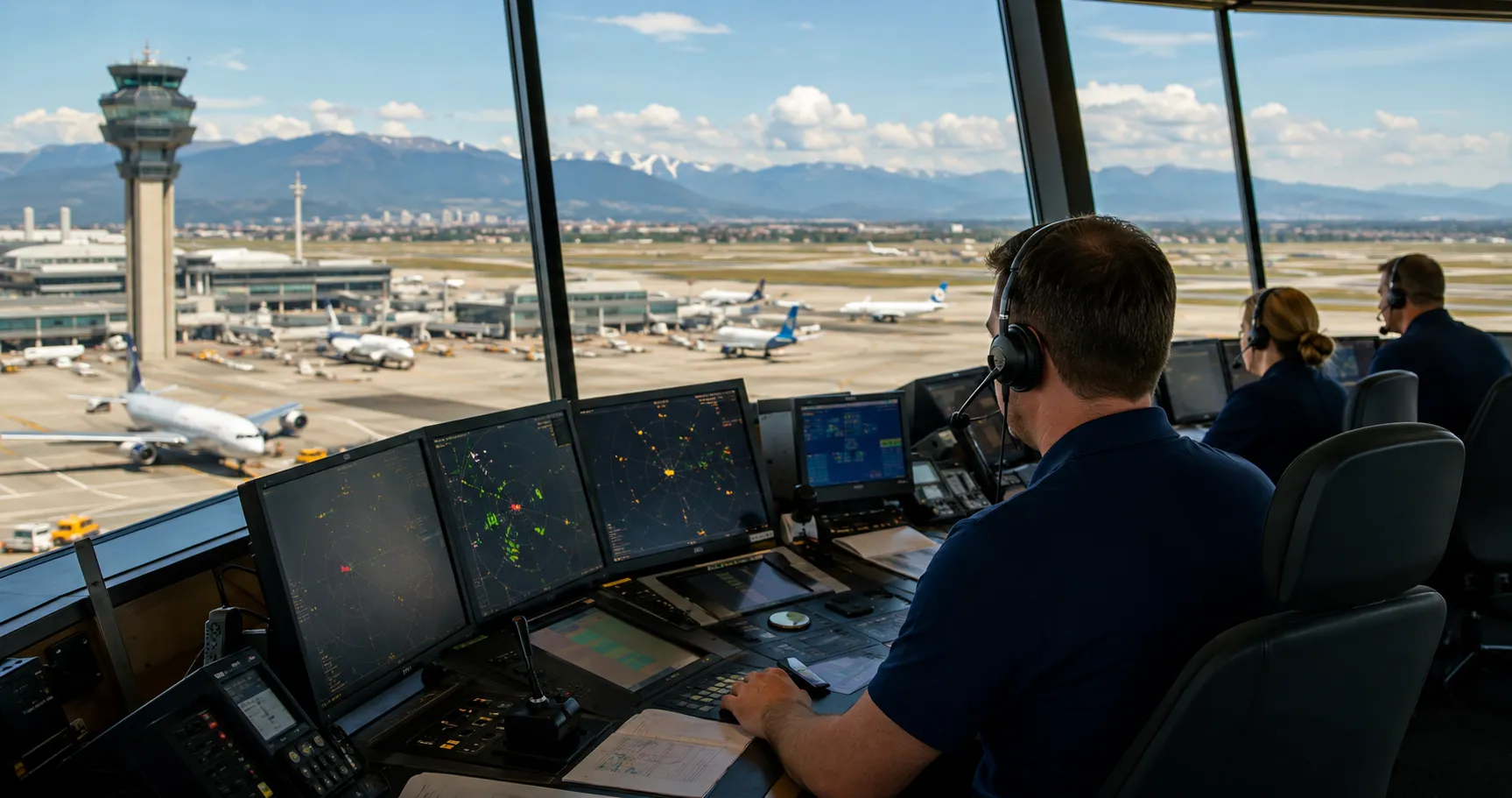
A tower controller works in an airport control tower and manages aircraft taking off, landing and moving around the airport.
Tower controllers normally have a direct view of airport runways and taxiways. They coordinate aircraft, airport vehicles and other traffic operating within the controlled area.
What Does an Area Controller Do?
An area control centre controller, sometimes known as an ACC controller, manages aircraft travelling through larger sections of Canadian airspace.
Area controllers normally use radar and other air traffic management systems to monitor aircraft. They provide instructions relating to altitude, speed, routing and separation while flights travel between airports.
NAV CANADA operates across seven Canadian flight information regions and assigns controllers according to operational staffing requirements.
What Are the Requirements to Become an Air Traffic Controller in Canada?
Applicants must satisfy NAV CANADA’s basic eligibility requirements before progressing to the assessment process.
| Requirement | What the applicant needs |
| Minimum age to apply | At least 18 years old |
| Education | High school diploma or recognised equivalent |
| Immigration status | Canadian citizen or permanent resident |
| Language | Fluent English, with English and French required for certain regions |
| Availability | Able to begin full-time training within 18 months |
| Mobility | Willing to relocate for training or employment |
| Medical fitness | Able to meet Transport Canada aviation medical standards |
| Security | Able to pass security and ongoing background checks |
| Drug screening | Able to pass pre-employment screening, including cannabis testing |
Applicants can apply to NAV CANADA from the age of 18. However, Transport Canada requires an applicant to be at least 19 before an air traffic controller licence can be issued.
Is a University Degree Required?
A university degree or college diploma is not required to become an air traffic controller in Canada.
The minimum educational requirement is normally a high school diploma or equivalent qualification. NAV CANADA provides the specialised classroom, simulator and operational training required for the position.
Degrees in aviation, mathematics, engineering or another technical subject may provide useful background knowledge, but they do not replace the NAV CANADA selection and training process. Candidates without post-secondary education can still qualify if they meet the eligibility requirements and perform strongly during testing.
Is Previous Aviation Experience Required?
Applicants do not need to be pilots or have previous professional aviation experience.
NAV CANADA provides the operational knowledge and technical instruction needed for the role. This includes aviation regulations, communication procedures, aircraft performance, meteorology, separation standards and air traffic control equipment.
A basic understanding of Canadian aviation may nevertheless help a candidate understand the profession and demonstrate a genuine interest during interviews.
Useful preparation may include learning about:
- Canadian airspace
- Airport operations
- Basic aviation terminology
- Aircraft types and performance
- Weather and its effect on aviation
- The difference between tower and area control
Previous experience in aviation does not guarantee selection because NAV CANADA evaluates the specific cognitive and behavioural abilities required for air traffic control.
How Can Someone Apply to Become an Air Traffic Controller?

Applications are submitted through NAV CANADA’s Workday careers portal when air traffic services positions are open.
Applicants are asked to provide details about their education, employment history and eligibility. They may also be asked about their preferred air traffic services stream and the regions in which they are prepared to work.
The general process is as follows:
- Confirm that all eligibility requirements are met.
- Review the tower and area controller career paths.
- Create an account through the NAV CANADA careers portal.
- Submit an online application.
- Complete the online assessment when invited.
- Attend the in-person cognitive testing session.
- Complete the assessment centre and interview.
- Complete any required language testing.
- Pass the medical, security and drug-screening requirements.
- Accept a training position and begin full-time instruction.
An application may remain active for up to 36 months. The time required to progress through the process varies according to assessment scores, course availability and regional staffing needs.
What Happens During the NAV CANADA Selection Process?
NAV CANADA uses several assessment stages to identify candidates who have a strong chance of completing training and working safely in an operational environment.
Successfully completing one stage does not automatically guarantee progression to the next stage.
What Is the Online Assessment?
Eligible applicants may receive an invitation to complete a timed online assessment.
The assessment takes approximately 30 minutes and can be completed remotely. NAV CANADA recommends using a desktop or laptop rather than a mobile phone or tablet.
Candidates who are unsuccessful at this stage may generally reapply one year after their testing date.
What Is Tested During the In-Person Assessment?
Candidates with competitive online results may be invited to an in-person testing session at a regional area control centre.
The testing normally takes approximately six hours and evaluates abilities such as:
- Memory
- Attention and concentration
- Spatial visualisation
- Information processing
- Working speed
- Logical reasoning
- Basic mathematics
- Decision-making
Successful candidates may also complete a brief pre-screening interview on the same day.
Candidates who are unsuccessful during the in-person testing stage may generally reapply after two years.
What Happens at the Assessment Centre?
The assessment centre is normally a half-day session involving individual exercises, group activities and an interview.
Assessors examine the candidate’s communication, teamwork, judgement, attitude and suitability for safety-sensitive work. Candidates should be prepared to discuss their employment history, educational background and reasons for pursuing an air traffic control career.
Candidates who do not pass the assessment centre may generally reapply after three years.
Is Language Testing Required?
All air traffic control applicants must be fluent in English.
Candidates seeking positions in Quebec or Ottawa generally need to be fluent in both English and French. NAV CANADA may arrange telephone language testing through a third-party provider to confirm proficiency.
What Medical Requirements Must an Air Traffic Controller Meet?
Air traffic controllers must meet Transport Canada’s aviation medical fitness standards.
For licensing purposes, an applicant must possess a Category 1 or Category 2 medical certificate that is valid for an air traffic controller licence. The assessment considers whether the applicant can perform safety-sensitive duties without a medical condition creating an unacceptable aviation safety risk.
An initial aviation medical examination must be conducted by a Transport Canada-designated Civil Aviation Medical Examiner, commonly called a CAME.
Candidates should be prepared to provide information about:
- Current and previous medical conditions
- Prescription and non-prescription medication
- Vision and corrective lenses
- Hearing
- Previous diagnoses and treatments
- Relevant medical tests
- Family medical history
The medical examiner submits the examination report to Transport Canada. Additional reports or specialist assessments may be requested when further information is needed.
Having a medical condition does not necessarily result in automatic disqualification. Transport Canada may assess the condition individually and may issue a certificate with restrictions where appropriate.
Do Applicants Have to Pass a Drug Test?
Air traffic control is designated as safety-sensitive work.
Candidates receiving an employment offer must complete pre-employment drug screening, including screening for cannabis. Employees must also continue to comply with NAV CANADA’s drug and alcohol policy throughout their employment.
Legal recreational cannabis use does not remove the obligation to meet workplace safety and testing requirements.
Is Air Traffic Controller Training Paid in Canada?
NAV CANADA air traffic controller training is paid.
Trainees receive a salary from the beginning of their training rather than paying tuition for a separate air traffic control course. The current published training salary starts at approximately CAD $58,606 per year and increases to approximately CAD $61,337 after one year in training.
Training is a full-time commitment. During the classroom and simulator phases, trainees generally complete a 37.5-hour week. During on-the-job training, air traffic control trainees normally move to shift work and a 34-hour week.
Trying to maintain another full-time job during training would be difficult. NAV CANADA describes the programme as intensive and performance-driven, with regular assessments and significant study required outside formal training hours.
How Long Does Air Traffic Controller Training Take?
The total duration depends on whether the trainee is assigned to tower control or an area control centre.
| Training route | Approximate total duration |
| Tower controller | 12 to 18 months |
| Area control centre controller | 20 to 27 months |
Training times may vary according to the complexity of the assigned location, course scheduling and the trainee’s progress.
How Does Tower Controller Training Work?
Tower controller training normally begins with approximately six months of classroom and simulator instruction.
Candidates assigned to complex towers may need additional simulator training based on the specific airport environment. They then complete approximately six to 18 months of supervised on-the-job training at their assigned tower.
During the final stage, trainees work alongside a licensed controller who serves as their on-the-job instructor.
How Does Area Controller Training Work?
Area controller training begins with approximately six to eight months of generic classroom and simulator instruction.
Trainees then complete approximately six to seven months of specialty-specific training using simulations based on the airspace they may eventually manage. The final phase involves approximately eight to 12 months of supervised operational training at an area control centre.
The trainee must meet all course, operational and licensing standards before becoming a qualified controller.
Where Does Air Traffic Controller Training Take Place?
Training may be conducted at regional facilities in locations such as:
- Vancouver
- Edmonton
- Winnipeg
- Toronto
- Montreal
- Moncton
- Gander
- Kamloops
- London
- Quebec City
The location offered will depend on NAV CANADA’s staffing and operational requirements. Candidates should not assume they will be trained or employed in their preferred city.
After classroom and simulator training, on-the-job training is completed at the operational location to which the candidate has been assigned. A person may therefore need to move to another province, territory or community.
How Much Does an Air Traffic Controller Earn in Canada?
Qualified air traffic controllers can earn substantially more than trainees.
NAV CANADA currently publishes the following base salary ranges:
| Air traffic controller position | Published annual salary range |
| Tower controller | CAD $104,258 to $207,450 |
| Area control centre controller | CAD $143,513 to $207,450 |
These figures reflect the published 2026 union pay ranges under the current collective agreement. Additional premiums may be available for shift work, holidays, location and other working conditions.
Actual earnings depend on the controller’s qualification, assigned unit, seniority, collective agreement provisions and applicable premiums.
What Hours Do Air Traffic Controllers Work?

Canada’s air navigation system operates 24 hours a day, every day of the year.
Qualified controllers therefore work rotating shifts that may include:
- Early mornings
- Evenings
- Overnight shifts
- Weekends
- Public holidays
Possible schedules may include several consecutive working days followed by a block of rest days. Hours and shift arrangements are governed by the relevant collective agreement and may differ between operational locations.
Applicants should consider whether they can manage irregular hours, disrupted sleep patterns and work during periods when many other people are off.
What Skills Are Needed to Become an Air Traffic Controller?
Academic qualifications alone do not determine whether a person will succeed in air traffic control.
NAV CANADA looks for candidates who demonstrate:
Strong Concentration
Controllers must maintain attention while monitoring aircraft, listening to radio transmissions and reviewing rapidly changing information.
Clear Verbal Communication
Instructions must be delivered confidently, accurately and without unnecessary wording. Controllers also need strong listening skills because misunderstanding a pilot’s message can create safety risks.
Spatial Awareness
Controllers need to understand the relative position, altitude, speed and direction of several aircraft, including aircraft that may not be physically visible.
Memory and Information Processing
The work requires retaining operational details while processing new information and anticipating what may happen next.
Decision-Making Under Pressure
Controllers frequently make time-sensitive decisions involving changing weather, traffic levels, equipment limitations and unexpected events.
Teamwork
Although each controller may manage an individual position or sector, air traffic control is highly collaborative. Controllers coordinate with colleagues, pilots, supervisors, airport staff and technical personnel.
Resilience
Trainees receive frequent feedback and must make immediate improvements. Successful candidates need to remain calm after mistakes, accept correction and continue performing under pressure.
How Can an Applicant Prepare for Air Traffic Control Testing?
There is no single academic course that guarantees success. However, candidates can develop relevant abilities before applying.
They can practise:
- Mental arithmetic without relying on a calculator
- Short-term memory exercises
- Spatial reasoning problems
- Tasks involving divided attention
- Reading and following detailed instructions
- Communicating information clearly and briefly
- Making decisions under strict time limits
- Working accurately despite distractions
Candidates invited to in-person testing may receive access to an official preparation platform. That resource should be prioritised because it reflects the format and competencies used in NAV CANADA’s process.
Preparation should focus on accuracy, consistency and understanding the instructions rather than trying to memorise unofficial test answers.
Can an International Student Apply?
International students and temporary foreign workers are not eligible solely on the basis of a study permit or temporary work permit.
NAV CANADA requires air traffic control applicants to be either:
- Canadian citizens, or
- Canadian permanent residents
A person who later becomes a permanent resident may apply once all eligibility requirements are satisfied.
Can Someone Choose Where They Will Work?
Applicants may be asked about their regional preferences, but their preferred location is not guaranteed.
NAV CANADA recruits according to operational demand. Successful candidates may receive an offer for a location that is far from their current home or in a smaller community.
Being genuinely willing to relocate can therefore be important. Candidates who are only prepared to work at one airport or in one major city may have fewer opportunities.
Relocation opportunities may become available later in a controller’s career, subject to qualifications, seniority, vacancies and operational requirements.
Is Becoming an Air Traffic Controller Difficult?
The process is deliberately difficult because air traffic controllers perform safety-critical work.
Candidates must pass several competitive assessments, meet medical and security requirements, complete intensive training and demonstrate operational competence in a real air traffic environment.
Not everyone who begins training becomes licensed. Trainees are evaluated throughout the programme and must consistently meet the required performance standards.
The challenge should not discourage suitable candidates. A person does not need a degree, aviation career or pilot licence. Strong cognitive ability, communication, resilience, discipline and willingness to learn can be more important than previous industry experience.
Is Air Traffic Control a Good Career in Canada?

Air traffic control may be a strong career option for someone who enjoys complex problem-solving, structured teamwork and work with significant responsibility.
The main potential advantages include:
- Paid professional training
- High earning potential after qualification
- Meaningful safety-related work
- Access to benefits and pension arrangements
- Opportunities to work with advanced aviation technology
- A career that does not require a university degree
However, applicants must also consider the demanding training standards, competitive selection process, rotating shifts, medical obligations and possibility of relocation.
The career is best suited to someone who can remain composed under pressure and maintain a high level of accuracy for extended periods.
Final Thoughts
The route to becoming an air traffic controller in Canada begins with an application to NAV CANADA rather than enrolment in a private aviation degree.
Eligible candidates must pass online and in-person assessments, demonstrate strong cognitive and communication abilities, meet medical and security requirements and complete paid professional training. The process can take more than a year, particularly for area controllers, and successful applicants must be prepared for full-time study, shift work and possible relocation.
For candidates who perform well under pressure and want a responsible aviation career without needing a university degree, air traffic control can offer challenging work, extensive training and strong long-term earning potential.
Information reviewed in July 2026. Recruitment availability, salaries and training arrangements can change. Candidates should confirm current requirements through NAV CANADA and Transport Canada before applying.
Frequently Asked Questions
What education is needed to become an air traffic controller in Canada?
An applicant generally needs a high school diploma or recognised equivalent. A university degree or college diploma is not mandatory.
Can someone become an air traffic controller at 18?
A person may apply to NAV CANADA at 18. However, Transport Canada requires an applicant to be at least 19 before an air traffic controller licence is issued.
Does an applicant need to be good at mathematics?
Applicants should be comfortable with basic mental arithmetic and numerical reasoning. Advanced university-level mathematics is not a stated entry requirement.
Does an air traffic controller need a pilot licence?
No. A pilot licence and previous flying experience are not required.
Is NAV CANADA training paid?
Yes. Air traffic controller trainees receive a salary throughout the programme. The published training salary begins at approximately CAD $58,606 annually.
How long does it take to qualify?
Tower controller training normally takes approximately 12 to 18 months. Area controller training normally takes approximately 20 to 27 months, although individual timelines may vary.
Is French required?
English fluency is required across Canada. English and French fluency is generally required for positions in Quebec and Ottawa.
Can permanent residents apply?
Yes. Canadian permanent residents and Canadian citizens may apply when they satisfy the other requirements.
How much do qualified air traffic controllers earn?
NAV CANADA’s published 2026 salary ranges run from approximately CAD $104,258 to $207,450 for tower controllers and CAD $143,513 to $207,450 for area controllers, before applicable premiums.
Can applicants choose their airport?
Applicants may state preferences, but training and employment locations are determined primarily by NAV CANADA’s operational staffing needs.