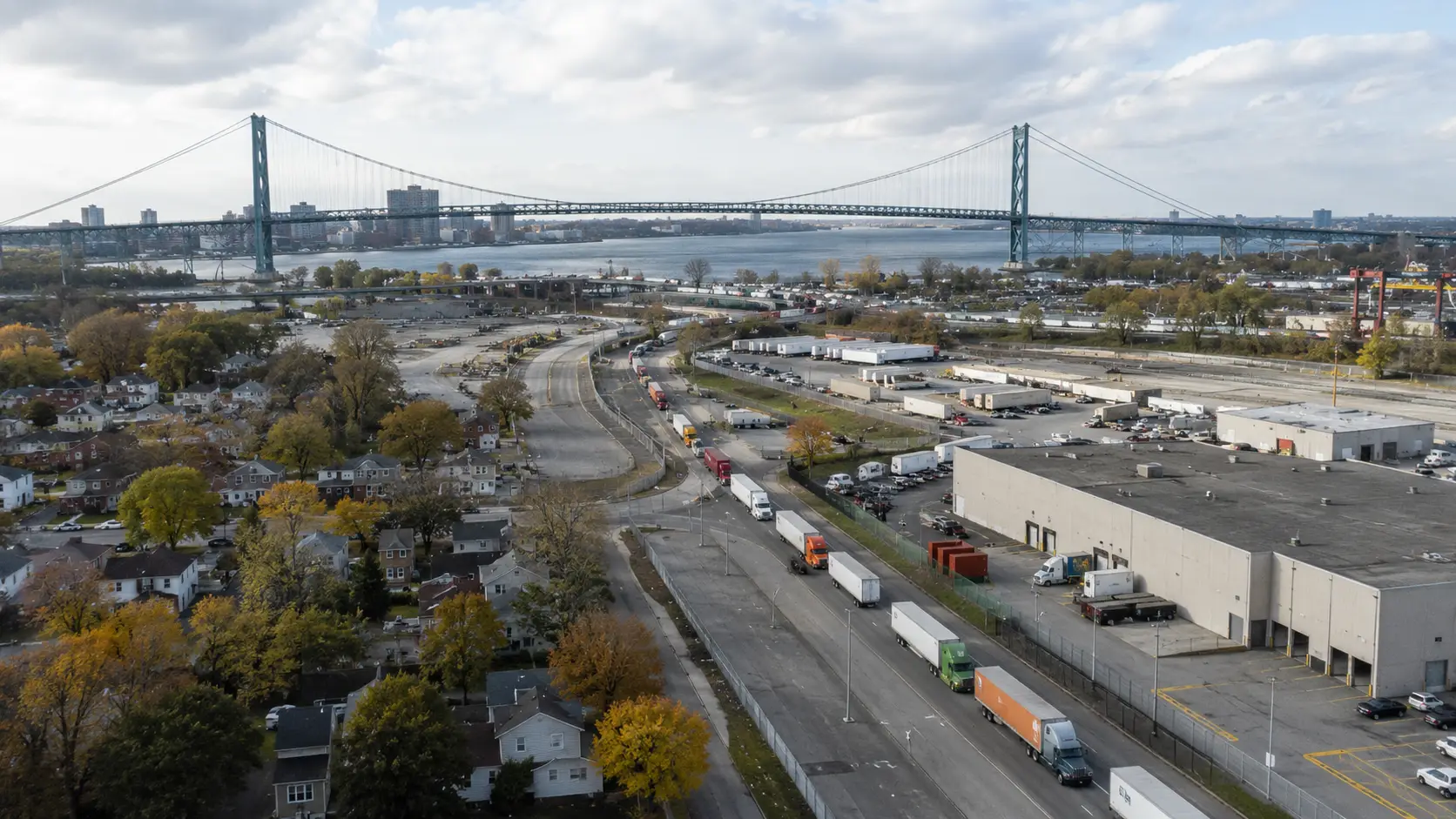

The Ambassador Bridge property dispute has become more than a local Windsor land-use issue. It sits at the intersection of private infrastructure ownership, municipal property standards, cross-border trade, neighbourhood planning and Canada-US transportation policy.
The Ambassador Bridge connects Windsor, Ontario with Detroit, Michigan and remains one of the most important commercial crossings between Canada and the United States.
For decades, the bridge and surrounding land have been tied to legal fights over expansion plans, access roads, property maintenance, border inspection facilities and the future of the Windsor-Detroit trade corridor.
For Canadian businesses, the dispute matters because the bridge is not just a piece of infrastructure. It is a strategic trade route that affects trucking, manufacturing, customs operations, logistics pricing, supply chain reliability and commercial real estate around one of North America’s busiest border gateways.
Businesses following wider trade and freight pressures can also read EN Business Canada’s coverage of Trump tariff shipping cost increases and broader updates in the Canada business category.
What Is the Ambassador Bridge Property Dispute?
The Ambassador Bridge property dispute refers to long-running disagreements involving land and properties near the Ambassador Bridge in west Windsor, especially in the Sandwich area. The dispute has involved the Canadian Transit Company, the City of Windsor, residents, courts and federal transportation rules.
At the centre of the issue are properties acquired near the bridge for possible bridge-related infrastructure, including expansion, border facilities, access improvements and related works.
Over time, some properties became vacant or derelict, leading to concerns about neighbourhood decline, property standards, municipal authority and the balance between national infrastructure needs and local community protection.
The dispute is closely connected to the privately owned Ambassador Bridge, operated through the Detroit International Bridge Company on the U.S. side and the Canadian Transit Company on the Canadian side.
It has also been shaped by federal oversight under Canada’s International Bridges and Tunnels Act, which governs the construction, alteration, maintenance, operation and ownership of international bridge crossings.
Why Does the Dispute Matter for Business News?
The Ambassador Bridge property dispute matters in business news because property control around border crossings can influence trade capacity, infrastructure investment and regional economic development.
For logistics companies, border reliability is a cost issue. Delays at Windsor-Detroit crossings can affect delivery schedules, inventory planning, automotive production and just-in-time manufacturing.
For property owners and investors in Windsor, the dispute raises questions about land value, zoning, redevelopment potential and public-private infrastructure conflicts.
For governments, the dispute highlights a major policy question: how should Canada manage privately owned infrastructure when that infrastructure serves a national economic function?
This is why the issue is relevant beyond Windsor. It connects local property standards with national trade strategy, private infrastructure rights and the future of Canada-US commerce.
Who Owns and Operates the Ambassador Bridge?
The Ambassador Bridge is privately owned and has historically been controlled by the Moroun family business interests. On the Canadian side, the Canadian Transit Company has been linked to bridge operations and land-related matters.
On the U.S. side, the Detroit International Bridge Company has been central to ownership and litigation.
This private ownership structure is one reason the bridge has generated repeated public-policy debate. Most major border infrastructure is either publicly owned or heavily controlled by government entities, but the Ambassador Bridge has long been an exception.
That creates a business tension. The bridge is a private asset, but it also performs a public economic function because it supports cross-border trade between Ontario and Michigan.
What Properties Are Involved Near the Bridge?
The properties most often discussed are located near the bridge approach in west Windsor, especially around the Sandwich neighbourhood. Some were acquired as part of bridge-related planning, including possible expansion, plaza improvements or replacement-span proposals.
The City of Windsor previously raised concerns about property standards and neighbourhood impacts. In earlier legal proceedings, Windsor issued repair orders against properties linked to the Canadian Transit Company.
The company argued that federal jurisdiction over the bridge and related works affected how local bylaws could apply, while the city maintained that property standards were a local matter.
This led to litigation, including the Supreme Court of Canada case Windsor (City) v. Canadian Transit Co., which became an important reference point in the broader jurisdictional dispute between local property regulation and federally significant infrastructure.
What Has Changed Recently?
A major recent development is that the Canadian Transit Company has been moving ahead with Canadian border services facilities work rather than a replacement bridge.
The company’s own update says the 2017 federal permit had authorised, subject to conditions, a replacement bridge and improvements to the Ambassador Bridge’s existing Canadian plaza. However, the company now says it is not currently planning a replacement bridge and is instead planning Canadian border services facilities work.
As part of that work, the Canadian Transit Company said it was undertaking pre-construction activities, including the demolition of houses in the project footprint and partial demolition of the West Ramp.
The company stated that the demolition process includes hazardous-material abatement, utility disconnection, demolition permits, fencing, demolition, material removal, regrading and permit closure with the City.
For businesses and residents, this matters because it signals movement from years of legal and planning uncertainty toward a clearer infrastructure footprint.
However, it does not remove all questions about land use, community impact, border capacity or the future role of the Ambassador Bridge after the Gordie Howe International Bridge opens.
How Is the Gordie Howe International Bridge Connected?
The Ambassador Bridge property dispute cannot be fully understood without the Gordie Howe International Bridge.
The Gordie Howe project is a publicly backed international crossing between Windsor and Detroit. Its official project materials describe it as a landmark infrastructure project designed to provide crossing redundancy, traffic capacity, expanded border processing and highway-to-highway connectivity.
That highway-to-highway connection is important. One long-standing criticism of the Ambassador Bridge is that its Canadian approach relies on Windsor streets rather than a direct freeway-to-freeway route.
The Gordie Howe Bridge is designed to connect more directly into major road networks, improving freight movement and reducing pressure on urban streets.
For businesses, the new bridge could reshape cross-border logistics, toll competition, truck routing, customs processing and commercial investment around Windsor and Detroit.
Is This Really a Property Dispute or an Infrastructure Dispute?
It is both.
At the local level, it is a property dispute because it involves land, vacant houses, repair orders, demolition, neighbourhood standards and municipal authority.
At the national level, it is an infrastructure dispute because those same properties are tied to a border crossing that supports trade between Canada and the United States.
At the business level, it is a market dispute because control of land near the bridge can influence future border capacity, toll revenue, freight routing and competition from the Gordie Howe International Bridge.
This layered nature is what makes the Ambassador Bridge dispute so important. It is not only about old houses near a bridge. It is about how Canada balances private investment, public infrastructure, local communities and international trade.
Why Did the Dispute Reach the Courts?
The dispute reached the courts because the Canadian Transit Company and the City of Windsor disagreed over how local property rules applied to properties connected to the bridge.
Windsor issued repair orders under municipal property standards rules. The company challenged aspects of that approach, arguing that the bridge and related works were federally regulated.
The legal conflict raised questions about whether the Federal Court or Ontario courts should deal with the issue, and how federal infrastructure jurisdiction interacts with local bylaws.
For readers, the key point is simple: the dispute was not only about whether properties needed repairs. It was also about which level of authority had power over land connected to an international bridge.
What Is the Role of the International Bridges and Tunnels Act?
Canada’s International Bridges and Tunnels Act gives the federal government authority over international bridges and tunnels. It requires approval for construction or alteration of an international bridge or tunnel and allows the federal government to impose conditions.
This matters because bridge-related property work is not treated like ordinary private development.
When land is connected to an international crossing, federal transportation, security, customs, environmental and public-interest considerations can become relevant.
At the same time, the existence of federal authority does not automatically remove all local concerns. Municipalities still have an interest in property standards, neighbourhood safety, planning, roads, demolition permits and community impacts.
That is why the Ambassador Bridge property dispute has been so difficult. It sits between federal infrastructure control and municipal land-use responsibility.
What Does the Dispute Mean for Windsor Residents?
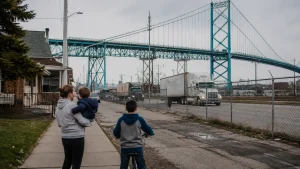
For Windsor residents, especially those in the Sandwich neighbourhood, the dispute has raised concerns about vacant homes, neighbourhood appearance, demolition, traffic, safety and long-term planning.
When bridge companies acquire many properties near a crossing, nearby communities can face uncertainty. Residents may not know whether land will become border infrastructure, parking, inspection facilities, commercial space or vacant lots.
That uncertainty can affect home values, business confidence and local redevelopment.
At the same time, demolition of vacant or deteriorating properties can be seen by some as a step toward reducing blight. The challenge is whether the next stage produces a clearer, community-sensitive plan or simply leaves residents waiting for more decisions.
What Does the Dispute Mean for Canadian Businesses?
For Canadian businesses, the Ambassador Bridge property dispute is important because it affects one of the country’s most strategic trade corridors.
Companies in trucking, warehousing, customs brokerage, auto parts, food exports, manufacturing and retail distribution all rely on predictable border movement.
When border infrastructure is uncertain, businesses may face higher risk in shipping schedules, route planning and cost forecasting.
The dispute also matters for commercial property. Land near major border crossings can become more valuable when infrastructure plans are clear. But when legal disputes, demolition, planning uncertainty and competing bridge projects overlap, investors may be more cautious.
For more trade-related context, EN Business Canada’s report on the Canada China canola EV exchange shows how transport, tariffs and market access can affect businesses across several sectors.
Could the Dispute Affect Trucking and Supply Chains?
Yes, indirectly.
The property dispute itself may not immediately stop trucks from using the Ambassador Bridge. However, land-use decisions around the bridge can affect future plaza design, inspection capacity, road flow, staging areas and customs processing.
If facilities improve, trucking companies may benefit from smoother operations. If uncertainty continues, companies may shift more planning toward alternative crossings, including the Gordie Howe International Bridge once fully operational.
The wider Windsor-Detroit corridor is vital because it supports automotive trade, industrial supply chains and time-sensitive freight.
Even small changes in border efficiency can create large downstream effects for manufacturers, carriers and exporters.
Why Is the Ambassador Bridge Still Important If the Gordie Howe Bridge Is Opening?
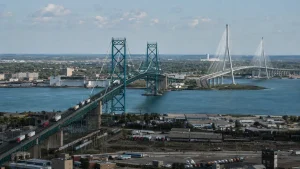
The Ambassador Bridge remains important because trade corridors need redundancy. A second major crossing does not make the existing bridge irrelevant. Instead, it changes the competitive and operational environment.
Once the Gordie Howe International Bridge becomes fully active, businesses may have more route options. That could reduce pressure on the Ambassador Bridge, improve resilience during disruptions and create toll and service competition.
However, the Ambassador Bridge still has location advantages, existing customer relationships and established infrastructure. Its future role may depend on how effectively it updates facilities, manages traffic, maintains public confidence and adapts to a more competitive border-crossing market.
What Are the Main Business Risks?
The main business risks are uncertainty, delay and fragmented planning.
If property, infrastructure and regulatory issues remain unresolved, companies may struggle to predict how Windsor-Detroit freight flows will evolve. If demolition proceeds without a clear redevelopment path, local business confidence may remain weak.
If new border facilities are delayed, the corridor may miss opportunities to improve processing capacity.
Another risk is community opposition. Infrastructure projects that are seen as ignoring neighbourhood impacts can face political resistance, legal challenges and reputational damage.
For investors, the safest reading is that land around the Ambassador Bridge remains strategically important, but also politically and legally sensitive.
What Should Businesses Watch Next?
Businesses should watch four developments.
First, they should monitor the Canadian Transit Company’s border services facilities work and any further demolition, permitting or site-preparation activity.
Second, they should watch the opening and ramp-up of the Gordie Howe International Bridge, because it may change truck routing and competitive pressure in the corridor.
Third, they should follow City of Windsor decisions on land use, demolition permits, property standards and neighbourhood planning around Sandwich and west Windsor.
Fourth, they should track federal transportation policy, especially any decisions under the International Bridges and Tunnels Act that affect bridge operations, ownership, alteration or inspection facilities.
Final Thoughts
The Ambassador Bridge property dispute is a local Windsor issue with national business consequences.
At one level, it concerns vacant properties, demolition and municipal standards near a historic bridge. At another level, it reflects a much larger debate about private control of essential trade infrastructure, federal oversight, community impact and the future of Canada-US supply chains.
For Windsor, the key question is whether long-running uncertainty can turn into a clearer plan for land use and neighbourhood renewal. For businesses, the key question is whether the corridor will become more reliable, competitive and resilient as the Gordie Howe International Bridge enters the picture.
The Ambassador Bridge may no longer be the only major story in Windsor-Detroit trade infrastructure, but its property dispute remains a critical signal of how Canada manages the land, law and logistics behind international commerce.
FAQs About the Ambassador Bridge Property Dispute
What Is the Ambassador Bridge Property Dispute?
The Ambassador Bridge property dispute refers to legal, municipal and infrastructure disagreements involving properties near the Ambassador Bridge in Windsor, Ontario.
It includes issues around property standards, land acquisition, demolition, bridge-related facilities and the balance between local and federal authority.
Why Are Properties Near the Ambassador Bridge Important?
Properties near the bridge are important because they may be needed for border inspection facilities, bridge approaches, customs infrastructure, demolition work or future operational changes. Their condition also affects nearby residents and local businesses.
Who Is Involved in the Dispute?
The main parties linked to the dispute include the Canadian Transit Company, the City of Windsor, residents in affected neighbourhoods, Canadian courts and federal transportation authorities.
Is the Ambassador Bridge Publicly Owned?
No. The Ambassador Bridge has historically been privately owned, which makes it unusual among major Canada-US border crossings. This private ownership is one reason the bridge has generated repeated legal and policy debate.
What Is the Gordie Howe International Bridge?
The Gordie Howe International Bridge is a major public infrastructure project connecting Windsor and Detroit. It is designed to improve border capacity, provide redundancy and create highway-to-highway connectivity.
Will the Gordie Howe Bridge Replace the Ambassador Bridge?
No. The Gordie Howe Bridge is not simply a replacement for the Ambassador Bridge. It adds another major crossing in the Windsor-Detroit corridor, creating more capacity and competition.
Why Does This Matter for Canadian Businesses?
It matters because border-crossing reliability affects trucking, manufacturing, customs brokerage, supply chains, warehousing, auto parts, agriculture exports and commercial property investment.
Could the Property Dispute Affect Trade?
The dispute may not directly stop trade, but it can affect long-term infrastructure planning, border facility upgrades, truck flow and investor confidence around the Windsor-Detroit gateway.
What Should Investors Watch?
Investors should watch demolition progress, property redevelopment plans, City of Windsor decisions, federal bridge approvals, Gordie Howe Bridge operations and changes in truck routing.
Is the Dispute Over?
No. Some property and demolition activity has moved forward, but broader questions remain about future land use, bridge operations, community impact and how the Ambassador Bridge will compete in a changing border infrastructure market.